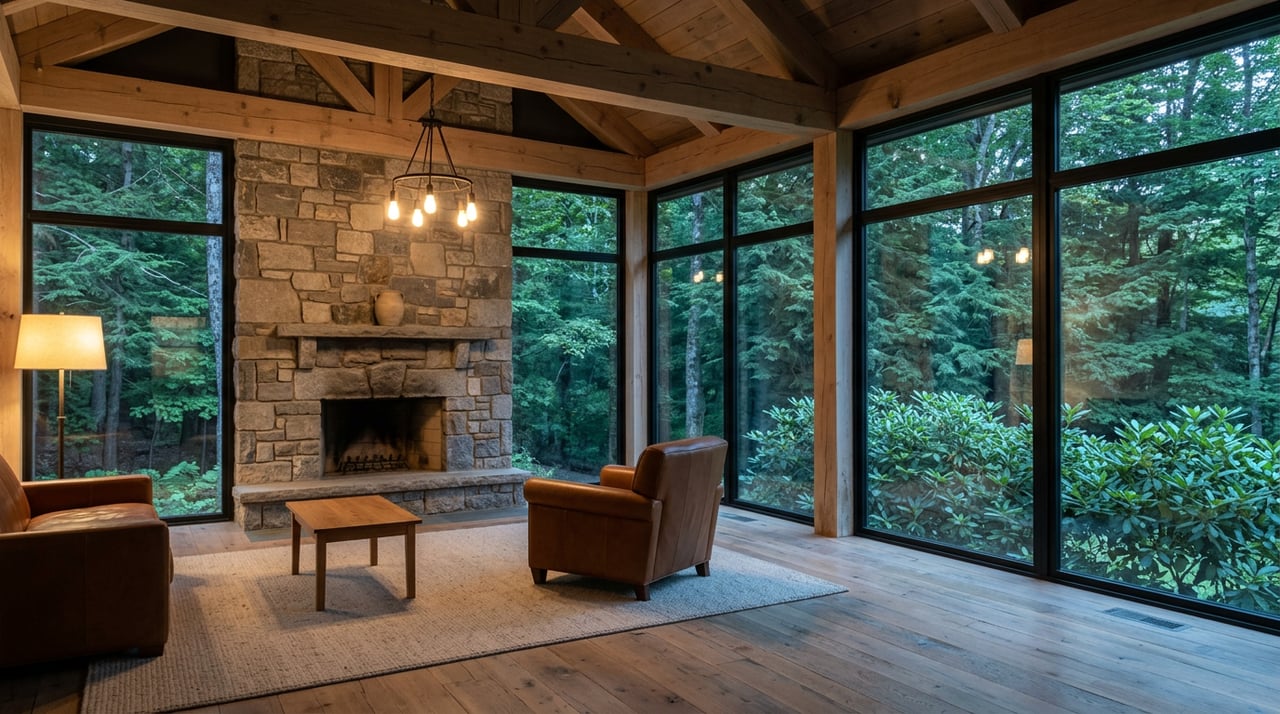
'Sleeps Twelve' Is a Marketing Claim. In Hocking County, It's About to Become a Legal Question.
September 10, 2026
September 10, 2026
A cabin in Hocking County burned to the ground. Nobody was inside, so the story never made headlines beyond the county line. But Audie Wykle, the county's regional planner, keeps bringing it up in zoning meetings, because the reason nobody got hurt was luck, not access. Fire trucks couldn't reach the cabin in time. The private driveway that served it, like hundreds of others tucked into the hills around Old Man's Cave and Ash Cave, wasn't built with emergency vehicles in mind. "What if we had a situation with a fire?" Wykle has asked publicly, more than once, and it's the question that set the county's current short-term rental ordinance in motion.
Most of the coverage of that ordinance has focused on driveways, addressing, and 24-hour local contacts. Those matter. But buried inside the same draft is a provision that touches something no listing photo will show you: how many people you're legally allowed to rent your cabin to. If you're looking at Hocking Hills property as an income-producing investment rather than a personal retreat, that provision, not the acreage or the price per bedroom, is the number that should shape your offer.
The Hocking Hills draws an estimated four million visitors a year, and short-term rentals have multiplied fast since 2020 to meet that demand. The City of Logan moved first, adopting its own short-term rental ordinance in late 2024 that caps occupancy at ten guests per unit, regardless of bedroom count, and requires one parking space per bedroom. Everything outside Logan's city limits, which is most of the cabin inventory buyers actually look at, has operated with far less structure.
That's changing. The Hocking County Zoning Commission, working with the county's Regional Planning Office, has spent the better part of a year drafting a countywide ordinance, gathering more than 400 responses to a public questionnaire before holding a packed town hall in October 2025 that drew over 100 lodging owners and supporters. Drafts moved from an August 2025 version through a "clean" version dated January 29, 2026. As of that most recent draft, the ordinance was still in progress, with a variance board yet to be formally created and some provisions, including the exact occupancy formula, still being negotiated line by line.
The draft ordinance doesn't leave "bedroom" open to interpretation. To qualify, a room needs at least 70 square feet for one person or 120 square feet for two, its primary use has to be sleeping, and it needs two means of egress, meaning two separate doors or windows, per Ohio's building code. The definition specifically excludes couches, daybeds, recliners, and futons placed in a living room.
That last exclusion is the one that matters most for anyone evaluating a cabin's income potential. A lot of Hocking Hills listings advertise sleeping capacity by counting every surface a body could lie on: a loft with two mattresses, a pull-out sectional, a daybed tucked into a reading nook. Under the draft ordinance, none of that counts unless the space independently meets the square footage and egress standard. A "sleeps 12" cabin might have four rooms that actually qualify as bedrooms, and everything else is just furniture.
The occupancy formula tied to that bedroom count is two guests per bedroom, with an exemption for young children. Here's where it gets interesting for due diligence: two separate news accounts of the same round of county meetings give two different answers for that exemption. One report, from WOUB in November 2025, says children under six don't count toward the limit. Another, from the Athens Messenger in December 2025, puts the cutoff at ten. That's not a rounding error. It's evidence that a provision directly tied to legal occupancy, and therefore to how many paying guests you can book, was still being rewritten as recently as last winter. Anyone underwriting a purchase on assumed occupancy numbers should treat the current draft as a moving target, not a settled fact, until the county adopts a final version.
Here's how the gap between a listing and the draft rule might look in practice:
| What the listing says | What the draft ordinance would actually recognize |
|---|---|
| "Sleeps 10-12 guests" | Occupancy tied to the number of rooms that meet the bedroom definition, at two guests each |
| Loft with two queen beds counted as sleeping space | Doesn't qualify as a bedroom unless it independently meets minimum square footage and has two means of egress |
| Living room sectional or daybed | Explicitly excluded from the bedroom count regardless of how many people it sleeps |
| Septic system originally designed for three bedrooms | Sets a hard ceiling on how many bedrooms the Health Department will certify, no matter how many rooms currently have beds in them |
That last row deserves its own explanation, because it's the part most buyers overlook entirely. Under the January 2026 draft, an STR permit application for a property on a septic system requires sign-off from the Hocking County Health Department as part of the minimum application requirements. That approval isn't a rubber stamp. Septic systems in Ohio are designed and permitted for a specific number of bedrooms, and the health department evaluates against that original design, not against how many beds are currently in the house.
The county's own property inspection process gives a sense of what that evaluation looks like. Existing systems don't have to meet current design standards, but they must have a visible riser to grade and show no sign of failure. The health department pulls a water sample and tests it for bacteria and nitrate contamination at a state-certified lab, with lead and arsenic testing available for an added fee. Pumping isn't required before the inspection, but a system that's failing, or one that was designed for two bedrooms and is now serving a five-bedroom cabin, is going to surface in that evaluation.
If you're buying a cabin and planning to add a bunkroom, convert a loft, or simply advertise more sleeping capacity than the current permit reflects, the septic system's original design is the ceiling you'll hit before the county's occupancy formula ever comes into play.
It's worth understanding that two different rulebooks are already operating side by side in this market. Inside Logan's city limits, the cap is flat: ten guests, period, regardless of how many bedrooms the home has. Outside the city, in unincorporated Hocking County where most of the cabin inventory sits, the draft ordinance ties occupancy to bedroom count instead. A five-bedroom cabin in the unincorporated county could theoretically host more guests than a five-bedroom cabin inside Logan's city limits once both rules are in force. Where a property sits on the map, not just how it's built, changes what you're legally allowed to do with it.
There's a second layer to this that has nothing to do with legal capacity and everything to do with demand. At the same meetings where the occupancy formula was debated, County Commissioner Michael Linton offered a blunter read on the market itself. "Maybe we're at the point where we have more cabins than we have demand for cabins," he said, pointing to a plateau in visitor traffic after the post-pandemic travel boom cooled. If that's accurate, the timing of a stricter occupancy ordinance couldn't be worse for anyone underwriting a purchase on the assumption that nightly rates and booking volume will keep climbing. A tighter legal ceiling arriving during a demand plateau is a combination worth pricing in conservatively, not optimistically.
A few questions are worth asking before you get to the closing table, not after.
Is the county ordinance already in effect? As of the most recent draft reviewed, dated January 29, 2026, it had not been finalized. Provisions including the age exemption for children have shifted between versions, so treat any specific number as provisional until the county adopts a final ordinance.
Does this affect cabins already operating as rentals? The draft includes discussion of a grandfathering provision for existing operators, though as of the most recent reporting, county staff indicated that question would be revisited once other requirements were settled. Buyers should confirm current grandfathering language before assuming an existing cabin's occupancy history will carry forward unchanged.
What if the property is on public water and sewer instead of septic? The draft's requirement for Health Department sign-off on permit applications applies specifically to septic-served dwellings. A property on public sewer wouldn't face that particular review, though it would still need to meet the bedroom definition and occupancy formula that apply countywide.
If you're evaluating a Hocking Hills property as an income investment, the acreage and the view matter, but they're not what determines your legal ceiling. That's set by a septic permit filed years ago and an ordinance still being written this year. Understanding both before you make an offer is the difference between underwriting a real number and underwriting a marketing claim.
If you're weighing a cabin, acreage tract, or retreat property in Hocking County and want a clear read on what a specific listing can actually support, Brandon Emmanuel can help you separate what's advertised from what's enforceable. Let's Connect.
Stay up to date on the latest real estate trends.
Get assistance in determining current property value, crafting a competitive offer, writing and negotiating a contract, and much more. Contact me today.