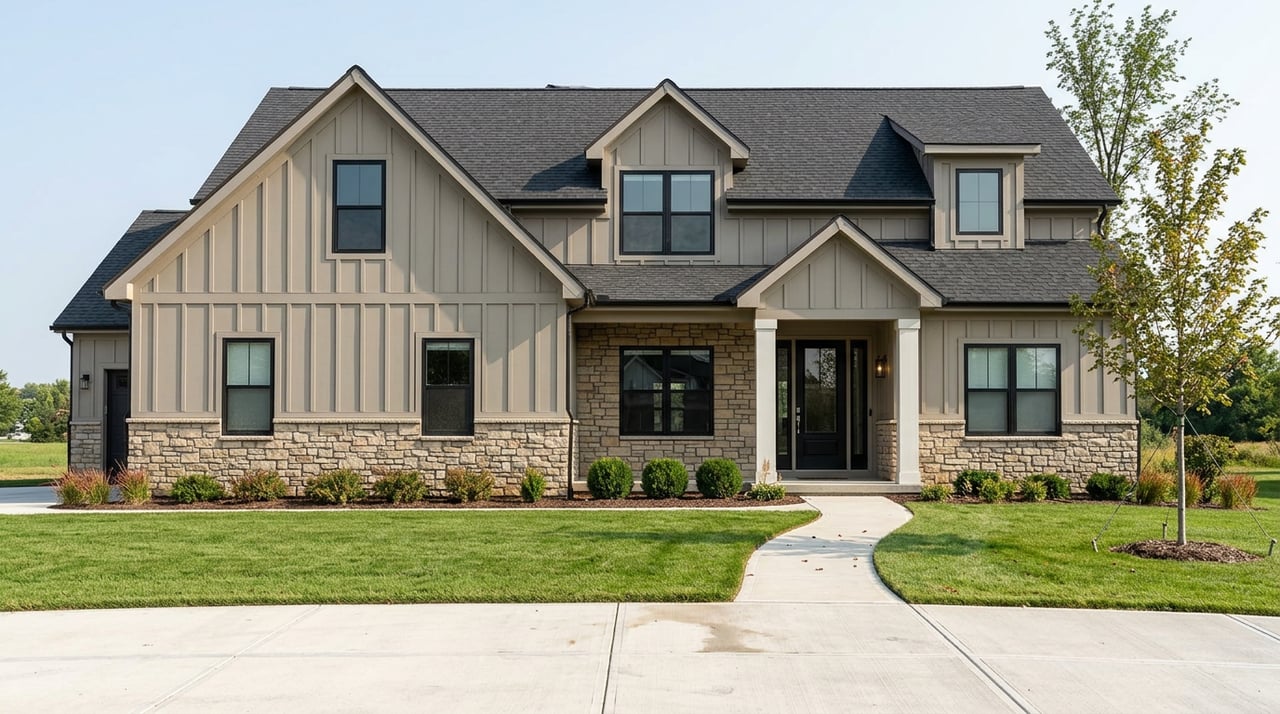
Building New in Delaware County: Zoning, Permits & Fees
August 20, 2026
August 20, 2026
Piatt Road and Peachblow Road in Berlin Township are the site of a roundabout construction project the Delaware County Engineer's office announced this year, with both roads closed for the work. If you are under contract on a new build anywhere near that intersection, your builder's move-in date and the county's construction calendar are now the same calendar, whether your purchase agreement mentions it or not.
That is the thing nobody tells buyers who are building new in Delaware County. The price on the builder's spec sheet is not the number that determines when you get keys or what you pay to connect. Two separate governments, each with its own clock, decide that. One is your township. The other is the county. They rarely move at the same speed, and almost nothing in a standard purchase agreement tells you which one is holding up your file.
If you are building in an unincorporated part of Delaware County, your project runs through a township zoning review and a county building permit, and those are not the same process with two names. They are genuinely separate reviews handled by separate offices, on separate timelines.
Genoa Township is explicit about how this works. Its Development and Zoning office reviews applications strictly first come, first served, regardless of the size or scope of the project. The township aims to respond within 72 hours, but its own zoning resolution gives it up to 30 days to render a decision, and that window can stretch further if a submission is incomplete or staffing is thin. The township also says plainly that it does not employ a civil engineer, so if your lot has a drainage question, you get referred out to the Delaware Soil and Water Conservation District rather than answered on the spot.
Berlin Township runs its own calendar of zoning appeals and architectural review hearings, and 2026 has been an active year for both. One case before the township's Board of Zoning Appeals asked to reduce the required front setback from a Class B road from 100 feet down to 50 feet. Another sought a variance to build a pool 20 feet into the 130-foot setback measured from the centerline of South Old State Road. Neither of those numbers appears on a builder's floor plan. Both determine whether the floor plan you picked can actually sit on the lot you bought.
None of this touches the county side. Delaware County Building Safety issues the actual construction permit, and the county's own permit guide is blunt about the split: if your parcel is inside an incorporated city, the city's building department handles it, not the county. If it is in unincorporated territory, the county handles the building permit while the township still controls zoning. Two offices, two files, two schedules, one house.
The variance cases above are not edge cases. They are what happens when a standard house plan meets a specific lot in a township with specific rules, and the plan does not fit without a hearing.
A 100-foot setback from a Class B road sounds like a formality until you are the one asking the Board of Zoning Appeals for permission to build closer to the road than the resolution allows. That is a public hearing, a posted agenda, and a waiting period, not a same-day signature. The same is true of the pool case near South Old State Road, where the setback is measured from the road's centerline rather than the property line, a distinction that catches out-of-state buyers and first-time builders more often than it catches experienced ones.
This is also why a builder's community-wide floor plan can move faster in one township than in the next. A plan that clears Genoa Township's review in three weeks might sit for two extra months in a neighboring township if it triggers a setback or architectural review question specific to that jurisdiction. The house is identical. The township is not.
Delaware County's larger growth story is not accidental. County officials have talked about it in exactly those terms. Evans Farm, a mixed-use community spanning more than 1,000 acres across Berlin and Orange townships off Lewis Center Road, has been held up publicly as a model for how the county wants to handle its own growth rather than simply absorb it.
One county official put the philosophy plainly:
"We know the growth is going to continue in Delaware County and we can't stop it."
Evans Farm was built around that idea, with shops, parks, and homes close enough together that residents are not funneling every errand onto the same two-lane roads. It is a deliberate answer to unmanaged growth, not proof that growth here has no friction left in it.
That friction shows up in a specific dollar figure that rarely makes it into a builder's marketing materials. The City of Delaware charges a water capacity fee of $4,912 per Equivalent Dwelling Unit and a sewer capacity fee of $3,145 per EDU, due when the building permit is issued. One EDU equals average daily water consumption of 360 gallons, and every single-family home is assigned exactly one EDU regardless of size.
| Fee | Amount | When it's due |
|---|---|---|
| Water capacity fee | $4,912 per EDU | At permit issuance |
| Sewer capacity fee | $3,145 per EDU | At permit issuance |
| Combined | roughly $8,057 | Before construction begins |
That is over eight thousand dollars that exists entirely outside the base price a builder quotes you, tied to the physical act of connecting a new house to the system rather than to the house itself. Ask early whether your builder is rolling this into your contract price or whether it lands on you separately at permit time. It is not negotiable with the builder. It is negotiable with nobody. It is simply owed.
Here is the part that should change how you read a builder's price tag. According to the most recent figures reported to the U.S. Census Bureau's Building Permits Survey, covering 2024, the city of Delaware issued 544 residential building permits worth a combined $255.9 million, with single-family homes making up close to two-thirds of that activity. Separately, total housing unit volume in the city for that year came in at 839 units, up 66.1 percent from the prior year, priced at roughly $305,000 per unit. That figure sits almost exactly in line with the broader Delaware County average of about $303,000 per unit for the same period.
That alignment matters. It means the widely repeated idea that new construction here carries some kind of premium over the rest of the county does not really hold up against the county's own permit data. What separates one new build from another in Delaware County is not primarily the sticker price. It is which township your lot sits in, how many EDUs you owe at permit issuance, and whether your setback matches what your specific township allows without a hearing.
If you are far enough along to be comparing builder contracts, ask three questions before you sign anything. Which specific township is this lot in, and what is that township's current zoning review timeline. Is the water and sewer capacity fee included in the contract price or billed separately at permit issuance. And is there any active county infrastructure work, like the Piatt Road and Peachblow Road roundabout, that could affect access to your lot during construction.
None of those questions will show up on a builder's glossy handout. All three determine whether your move-in date holds.
Does the township or the county issue my building permit? It depends on where the lot sits. Incorporated cities like Delaware handle their own building permits. Unincorporated county land splits the work: the township controls zoning, Delaware County Building Safety issues the construction permit.
Who actually pays the water and sewer capacity fee, me or the builder? The fee is billed to whoever pulls the permit, which is often the builder, but the cost is typically passed through to the buyer one way or another. Get this in writing before you sign.
How long should I expect zoning review to take? Genoa Township's own resolution allows up to 30 days for a decision, longer if the application is incomplete. Other townships run their own boards of zoning appeals on their own hearing calendars, so a variance request can add months rather than weeks.
Buying land or a floor plan in Delaware County is still a good decision for a lot of buyers. It just is not a decision you should make off a builder's price sheet alone. The township lines, the fee schedules, and the county's own construction calendar are doing as much work as the house itself.
If you are weighing a specific lot or builder contract in Berlin, Genoa, Liberty, or Orange Township and want a second set of eyes on the timeline before you sign, Brandon Emmanuel can walk through what your specific parcel is actually subject to. Let's connect.
Stay up to date on the latest real estate trends.
Get assistance in determining current property value, crafting a competitive offer, writing and negotiating a contract, and much more. Contact me today.